Fundraising trends in sport for good; reflections, challenges and a call to action.
When Rahul and I first came up with the idea of a global survey to assess the state of the sector back in 2020, we were primarily motivated by one overarching question: what financial impact was the Covid-19 pandemic having on sport for good organisations across the world? The answer, predictably, was emphatic: it had been catastrophic.
Across the board, income levels were down. Fundraising activities, events and investment were - understandably - roundly cut or deprioritised. Never before had the outlook seemed more uncertain, more difficult to predict. But there was a glimmer of hope; confidence levels for the future were relatively high (all things considered), which spoke to the determination and optimism that so characterises the sector. It was, therefore, more instructive to observe what happened next.
Trends and themes: 2021-24
Through an annual global survey of sport for good organisations – from grassroots NGOs through to multi-national networks – we set out to determine the relative financial health of the sector. From income levels and predominant fundraising sources through to skills, strategy and confidence – we wanted to measure all pertinent factors. Having the annual dataset enabled us to compare year-on-year trends, identify common challenges and understand some systemic issues impacting financial sustainability.
Some of the primary takeaways:
Positives:
- Trusts and Foundations. Consistently representing more than half of all income reported across the sector, this is the preponderant stream and has shown itself to be a reliable source of funding for organisations on every continent
- Recovery. Despite a slow start, there has been year-on-year growth in donations from individuals and corporate partners. Driven by innovation and perseverance, there has been an incremental upward shift in fundraising performance
- Diversification. Those organisations who were most resilient through the initial tumult of the pandemic were those with diverse income streams. A holy grail that we all aim for, income diversification is much easier-said-than-done. However, we’re getting there. T+Fs might still be the largest single funding source - and overall contribution is increasing - but its proportion of overall sector income is decreasing. This shows that all sources are going up and the sector is steadily reducing that precarious reliance on a single stream
- Confidence. That initial seed of optimism from the original survey has only grown year-on-year. Albeit a less tangible measure, this has always been a key marker: how does it feel on the ground?
Challenges
- Systemic inequalities. The research has highlighted how, in so many ways, funding systems and mechanisms are unfit-for-purpose. Unequal geographic distribution, prioritisation of already-well-funded and established organisations, Anglo-centric language bias, complicated funding processes – these are just a few of the common barriers that have been prevalent since the very first report
- Skills deficit. There is a distinct lack of fundraising expertise, knowledge and capacity across the sector. It is under-invested, insufficiently prioritised and lacking in network support and infrastructure
- Lack of strategy. Even in 2024, almost half of organisations in the sector do not have a fundraising strategy. The reasons for this are manifold and connected to the skills deficit, but ultimately serve as a fundamental barrier to sustainability
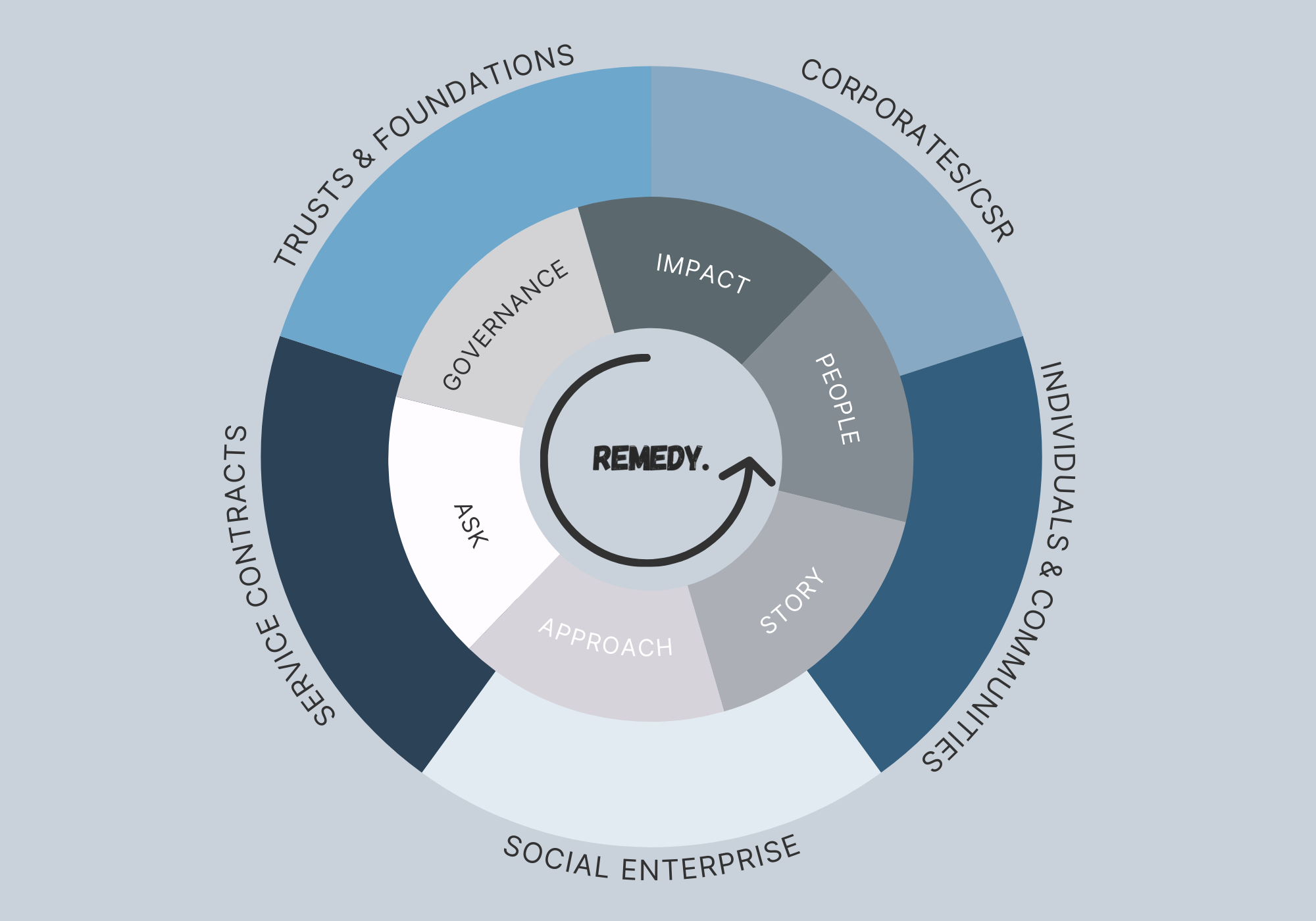
- Readiness. If you’ve seen any of our work to-date then you’ll know that fundraising readiness is something we talk about a lot… and for good reason. Year-after-year, the same issues come to the fore: governance, storytelling, impact measurement, skills and capacity, approach and ask – all underdeveloped and requiring significant work.
What needs to happen?
Well, a lot. Addressing these challenges was the motivating force behind us forming Remedy. We are on a mission to democratise access to fundraising skills and support, and this won’t happen overnight. Nor is there a singular problem to be tackled; realising this mission requires progress against a host of areas from a number of purposeful and determined stakeholders.
The utopian vision we have for the sector will likely take a few years to manifest and requires some substantial shifts in policy-making and funding systems… so let’s break this down into some more achievable objectives that can still take us a long way.
1. Capacity building. Long-term, structural changes will not be sustainable without an intentional approach to building the sector’s fundraising capacity. Networks, funders and policy-makers must recognise the importance of investing in training, tools and resources to develop the skills and confidence of fundraising practitioners in the sector.
2. More equitable distribution. The stratification of funding across different territories is stark, with a grossly disproportionate share of income going to European- and US-based organisations. This only serves to exacerbate other acute challenges in those under-resourced areas, particularly around fundraising readiness and capacity, deepening the sustainability chasm.
3. Systemic funding practices. Institutional and trust and foundation funding systems need to be simplified, more accessible and more coherent. Resources and capacity are so stretched across the sector, and yet so much precious time is wasted on applications to funders that stand little-to-no chance of success. Processes vary wildly and require organisations to create lots of new information each time they apply for funding. Processes are often Anglo-centric in language and biased towards those who can write compelling narratives, with limited alternative means for organisations to demonstrate impact.
4. Collective action. There are a number of funding bodies who regularly invest in sport for good causes. However, to realise the sector’s full potential, we need to think differently and target prospective donors and partners from outside ‘traditional’ sources. To raise awareness of sport for good’s efficacy, there must be a concerted, collective effort to effectively communicate the sector’s value. We need more consistent language, shared impact frameworks and a joined-up approach to MEL and advocacy.
5. Infrastructure costs. The landscape is positively shifting in the right direction, but funders must be prepared to support organisations’ core overheads. Programmatic funding is essential, but will be inherently limiting if it is not supported by investment into the sector’s indirect costs. Breaking the transactional funding cycle of trying to find funding to cover staff costs and overheads will catalyse innovation, more strategic approaches and a longer-term focus.
6. Embrace innovative funding models. So much of the sector’s work is pioneering and progressive, yet funding models and approaches tend to lean towards the traditional. This is easy to understand – and tried-and-tested models should be an essential part of the fundraising mix – but there are opportunities to be more experimental too. Fund strategies, not projects. Remove arbitrarily restrictive eligibility requirements. Value learning, not just outcomes. Prioritise support, not bureaucracy.
What next?
We are determined to support the sector to become more sustainable, more progressive. This includes working with grassroots organisations and NGOs to build capacity, and working with funders and donors to become more accessible. We have big plans in this area for the months and years ahead, but want to hear from others in the sector too. If any of this resonates with you, please get in touch – we’d love to talk.
Written by Luke Southall